Article
New ISPOR Findings on Generative AI in Systematic Literature Reviews: What Does It Mean for Evidence Generation?

New ISPOR guidance on Generative AI in Systematic Literature Reviews: what does it mean for evidence generation?
A newly published ISPOR Special Task Force report provides the first formal good practice recommendations for the use of Generative AI (GenAI) across systematic literature review (SLR) workflows. The message is clear: GenAI can enhance evidence synthesis, but scientific accountability remains with researchers and review teams.
From a SPARK perspective, this guidance reinforces that the question is less about whether AI should be used, and more about where and how it can be applied responsibly while maintaining scientific rigour.
Key reflections for evidence teams
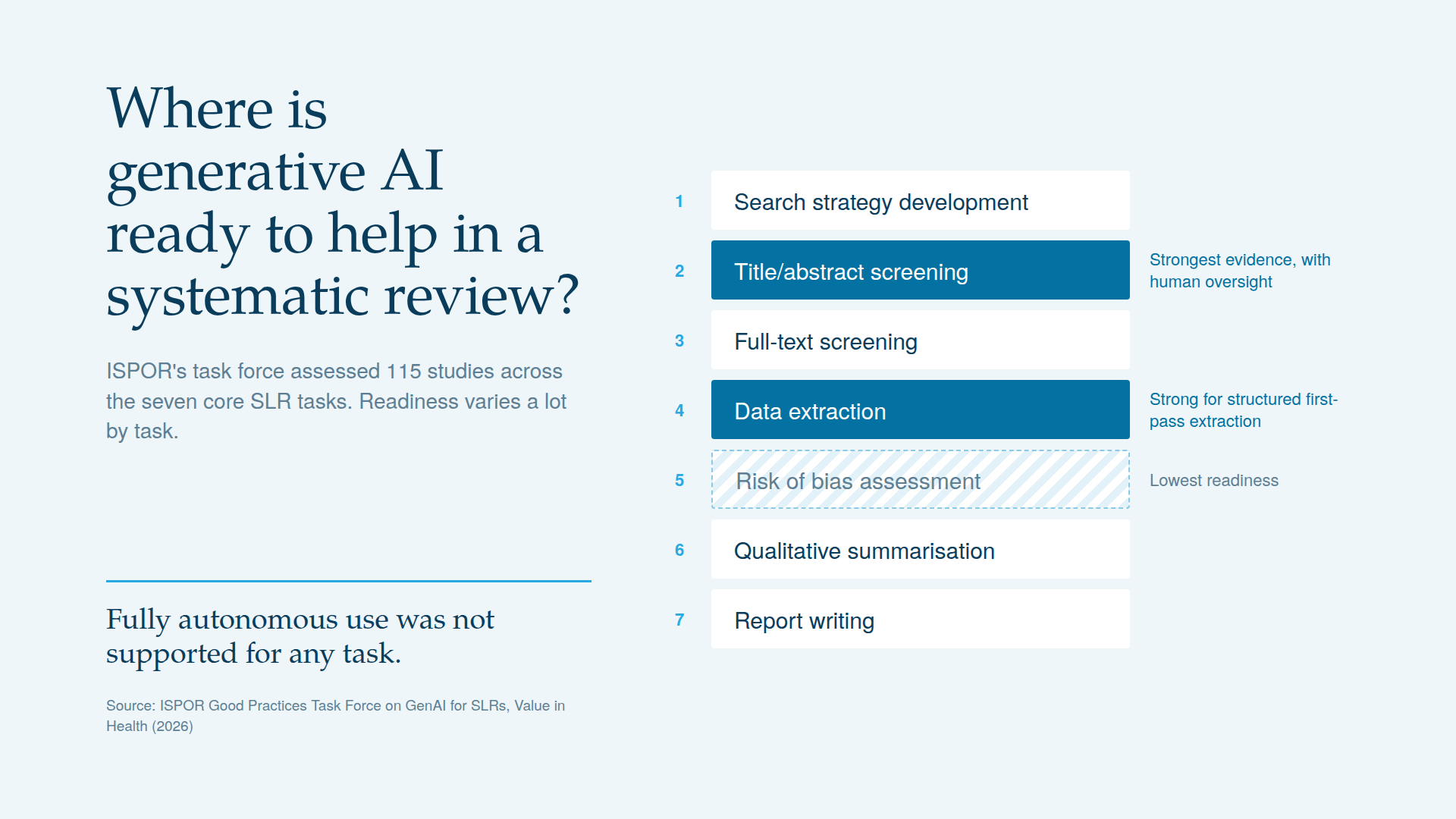
- Expert oversight remains essential: The strongest evidence currently supports AI-assisted title/abstract screening and structured first-pass data extraction, but with explicit oversight and review processes. Fully automated SLRs are not recommended. Oversight is not only about catching errors: experienced reviewers recognise which studies fill an evidence gap or will matter most for decision-making, and that judgement is difficult to automate.
- Transparency is becoming a methodological expectation: AI use should be documented as a core component of the review methodology, not treated as a “black box” productivity tool. This has implications for protocols, reporting standards, auditability, and stakeholder confidence.
- Not all SLR tasks are equally ready for AI: The report suggests greater readiness for screening and structured extraction, while more interpretive activities such as risk-of-bias assessment remain challenging and require significant human judgement.
- Methodology matters as much as the technology: The most reliable results were observed when AI operated within clearly defined workflows, with pre-specified rules, escalation pathways, and conflict-resolution processes.
What does this mean for wider evidence generation?
While developed for SLRs, many of the underlying principles are equally relevant to HEOR, HTA and real-world evidence (RWE) generation, where transparency, reproducibility and appropriate human oversight remain critical:
- Focus on augmentation rather than replacement
- Build governance alongside innovation
- Prioritise reproducibility, traceability and auditability
- Match AI tools to the right task rather than seeking end-to-end automation
- Keep scientific accountability and interpretation with experienced evidence teams.
Perhaps most importantly, this publication acknowledges that the landscape is evolving rapidly. Recommendations are based on evidence available up to mid-2025 and will require ongoing reassessment as GenAI capabilities continue to mature.
For evidence-generation teams, this guidance represents an important milestone in moving discussions about AI from experimentation towards more structured and accountable implementation. Whether in literature reviews or RWE generation, the opportunity lies in deploying AI thoughtfully: focusing on tasks where it adds value, ensuring transparent and reproducible methods, and keeping expert judgement at the centre of decision-making.